Field report · May 28, 2026
Texas Military Forces Museum
Our field report from Camp Mabry, Austin
📋 See the trip plan for this adventure →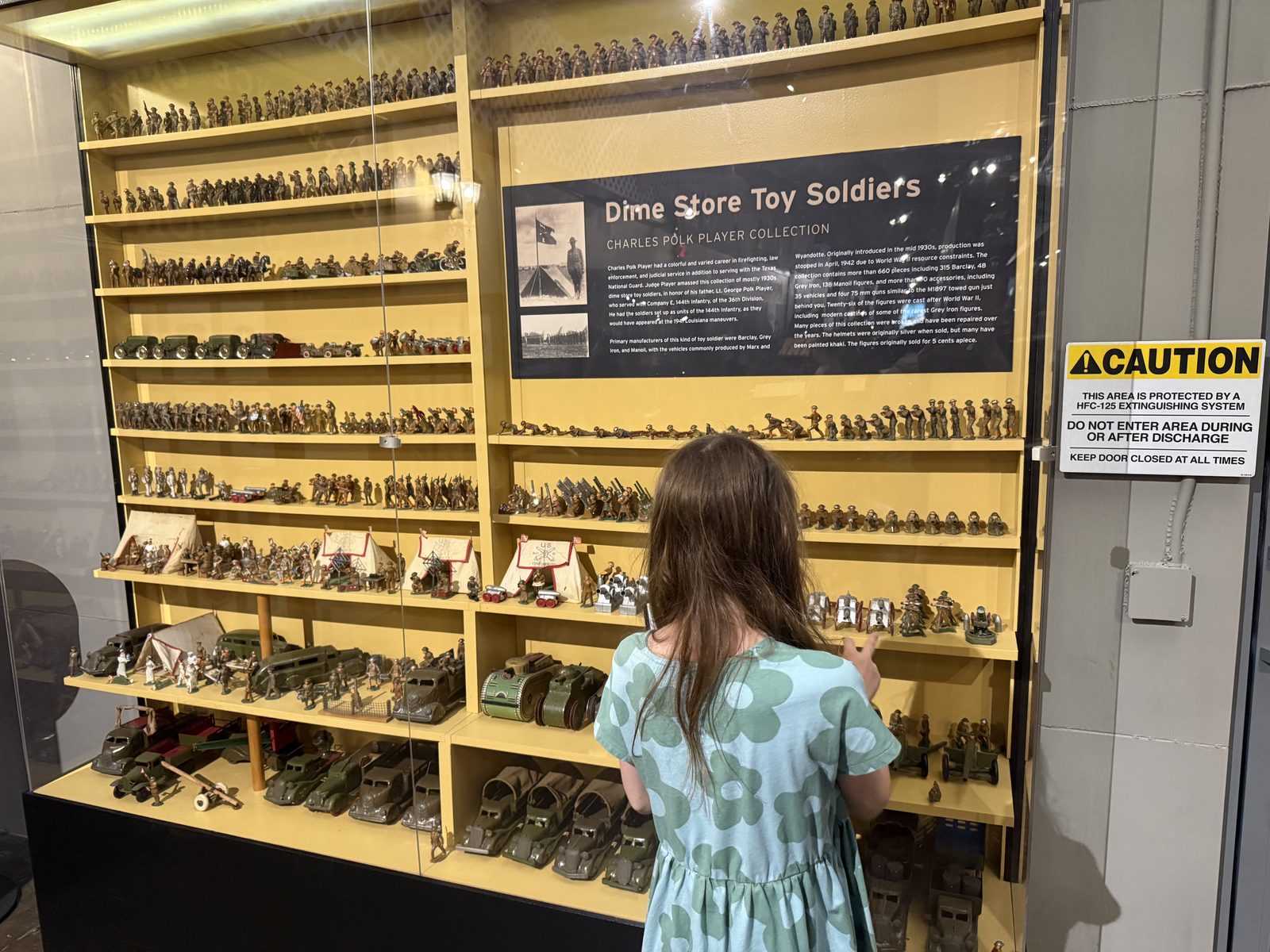
On May 28, 2026 we drove up to Camp Mabry in Austin to visit the Texas Military Forces Museum, the official museum of the Texas National Guard, tucked inside a working military base. You need a photo ID just to clear the gate. Inside is a 45,000-square-foot hall that walks you from Stephen F. Austin's frontier militia in the 1820s all the way to the tanks parked on the lawn today, with the 36th Infantry Division (the "Texas Army" of World War II) as the beating heart of it. Maxine took a lot of pictures and read a lot of placards. This is what we saw and what we learned, roughly in the order we walked through it.
Walking In: A Wall of Tiny Soldiers
The very first thing that stopped us wasn't a tank. It was a glass case packed with hundreds of dime-store toy soldiers. A judge named Charles Polk Player built the whole collection to honor his father, and there are so many little lead figures that you could lose an afternoon just counting them. They even built tiny scenes: a miniature Signal Corps camp with working lights, and a hard-hat deep-sea diver with a coiled air hose. It turned out to be the perfect way to start, because the rest of the museum is about real people who were once exactly this size to history, small figures in something enormous.
The Things We Weren't Expecting
Before the museum settled into neat chronological order, a few objects grabbed us out of nowhere. There was a Japanese helmet made of metal so poor the card said it would barely stop a rock. There was a recreated radio command room with a soldier frozen mid-message. We got to climb right into a fighter cockpit while a docent explained the controls. And there was a French boxcar stenciled "HOMMES 40, CHEVAUX 8" ("40 men, 8 horses"), one of the "Forty and Eight" cars France sent back to the United States in 1949 on the Merci (Thank-You) Train, loaded with gifts to thank Americans for help after the war. But the object we keep thinking about was small and dented: a tin canteen. A soldier named C.J. Eaton of the 2nd Battalion, 131st Field Artillery (the "Lost Battalion") scratched the name of every place the Japanese imprisoned him into the metal: Hawaii, Fiji, Australia, Java, Singapore, Formosa, Japan. Three and a half years of captivity written on a water bottle.
World War I: Machine Guns and Field Guns
The First World War section is full of the machines that made that war so terrible. The German MG08 machine gun was basically a copy of the Maxim gun. The American Marlin "Potato Digger" earned its nickname because a lever swung down underneath it like it was digging at the dirt. There was a French Hotchkiss built from only 32 parts so a soldier could field-strip it fast, and a pair of Model 1917 machine-gun carts, because before you can fire a heavy gun, somebody has to haul it through the mud. We hadn't really thought about how much of war is just moving heavy things.
The Great Hall: American Iron and Captured Steel
Then the ceilings open up and you're standing among the actual vehicles. An M4 Sherman is genuinely huge in person. The U.S. built almost 49,000 of them while Germany built only a few thousand of its big cats, and that number alone basically explains a lot about how the war went. One Sherman is a "please touch" exhibit, and the sign said it took 83 rubber track shoes to shoe the thing. Across from the American armor sit the captured German machines: a Kübelwagen (Germany's jeep, designed by Porsche), a desert-tan Sd.Kfz. 251 half-track still wearing Afrika Korps markings, and a low, sneaky Jagdpanzer 38 "Hetzer" tank destroyer with three-color camouflage. There are even crossed-steel "hedgehog" obstacles. The Czechs invented them, and the clever part is that they don't blow a tank up, they just lift it until its tracks can't grip. Tucked in among all the steel are the "Twin Sisters," replica cannons standing in for the two guns Texians fired at the Battle of San Jacinto in 1836. The originals were lost, and the placard tells the long detective story of people still hunting for them.
The Man the Camp Is Named For
Camp Mabry is named after General Woodford H. Mabry, and his actual dress uniform is on display, gold cords and all. What we learned later is that the camp got his name by a vote: after he died, most of the state's militia companies balloted to name the post after him. We can't think of many army bases that were named by the soldiers themselves.
Texas Goes to France: The 36th Division in WWI
This whole gallery is the story of the 36th Infantry Division (the "Texas Army") being born and shipped to France in 1918. Our single favorite fact of the day is hiding here: the museum building we were standing in used to be a mess hall and bakery for the WWI School of Automobile Mechanics. We were learning about 1918 inside a building from 1918. The division's first real battles were at St. Étienne and Blanc Mont, and the gallery recreates a "Post of Command," the field headquarters. (We didn't know the phrase "command post" didn't even exist yet. In WWI they said "Post of Command.") A "PC" might be a shell hole, a grove of trees, or a bunker dug underground to hide from artillery. And then there's the part we think is the coolest in the entire museum: the Choctaw Code Talkers. In October 1918, Choctaw soldiers in the 36th transmitted orders over field telephones in their own language, and the Germans, who were tapping the lines, couldn't understand a word of it. It was the first time Native American code talkers were used in U.S. military history, a full generation before the famous Navajo code talkers of WWII. The thing that gets us is the bitter twist underneath it: the language worked as an unbreakable code because the U.S. had spent decades trying to stamp it out.
Baptism of Fire: Salerno and the Italian Campaign
When World War II came, the 36th was federalized and trained from Camp Bowie to North Africa, and then on September 9, 1943 it became the first American division to land on the mainland of Europe, storming ashore at Salerno, Italy. The Germans nearly threw them back into the sea on the first day. The placard calls it the division's "baptism of fire," and the casualty chart for those few days is brutal. Up the Italian boot, the fight for the town of San Pietro became famous: the director John Huston filmed it, and the war correspondent Ernie Pyle wrote his most heartbreaking column about Captain Henry Waskow, a Texas Guardsman from Belton who was killed leading Company B. Near the panels is the actual battle-damaged helmet of Captain Ausy Brown with a jagged shrapnel hole torn through it. It's from the Rapido River, the costly crossing the 36th's veterans were so angry about that they later forced a Congressional investigation of the general who ordered it.
The Other D-Day: Southern France and the Vosges
Most people only know about D-Day in Normandy, but the 36th got a second D-Day: Operation Dragoon, the invasion of southern France in August 1944. After the Velletri breakthrough in Italy (the diorama for it genuinely blew our minds, with the whole hillside attack built in miniature), the Texans landed in France and raced inland fast. One panel said they covered 250 miles in eight days before the brutal, freezing fight through the Vosges Mountains. We also liked the parts about people who weren't doing the shooting: the Texas Defense Guard that protected the state while the National Guard was overseas, and the "Donut Dollies," Red Cross women who drove a converted truck up near the front handing out coffee and doughnuts. A life-size 1944 infantryman kneels in a brick ruin, and a "By the Numbers" panel is wall-to- wall facts: the average draftee was 5 foot 8 and 144 pounds, and by 1945 over 12 million Americans were in uniform.
The Last Winter: From the Bulge to the Death Camps
The final stretch of the WWII gallery is the hardest. It starts with the combat medics. The case has a real first-aid pouch, a bandage stamped "PUT OTHER SIDE NEXT TO WOUND", and a jar of jagged shell fragments, because artillery caused something like 80% of all casualties. There's a German "Bouncing Betty" mine that springs up to waist height before it explodes, and a captured MG 42 that G.I.s nicknamed "Hitler's Buzz Saw" because it fired so fast it sounded like ripping cloth. Then comes the panel we won't forget: in April 1945 the T-Patchers liberated Landsberg, a sub-camp of Dachau. One officer said what he saw there made him ashamed to be a member of the human race. A casualty chart nearby counts almost 11,000 of the division's men lost in battle in just the last nine months, and a note underneath says that's only battlefield losses, not the ones sent home with trench foot or sickness. The very last panel by the exit is a Memorial Day 1945 speech. It's a heavy way to leave a gallery, and we think that's on purpose.
The Cold War Motor Pool
After the war galleries, you walk into a yard of olive-drab trucks and jeeps from the 1950s through the 1970s. The tiny M274 "Mechanical Mule" is an 880-pound flatbed cart that could carry a recoilless rifle, and the M151 "MUTT" jeep had such a bad habit of rolling over that they had to bolt a roll-cage onto it. The best part: we got to climb inside an actual M211 field-kitchen truck, a rolling Army mess hall with stoves, cabinets, and an "immersion heater" that was basically a gasoline burner you dropped into a can of water to do the dishes. We opened the cabinets to see what a soldier's kitchen carried around.
Korea and the Air War
The Texas Air National Guard has its own story, anchored by a silver Republic F-84E Thunderjet hanging with FS-189 painted huge on its nose. Our favorite story is about the pilots over Korea: since they mostly bombed and strafed instead of dogfighting, they invented their own kinds of "aces": locomotive aces, tunnel aces, bridge aces, even a "camel ace." They also pioneered air-to-air refueling, and one time a flight of 32 jets glided home with their engines shut off to save fuel. There's a little bubble-canopy OH-23 helicopter here too, the kind used to scout and carry wounded.
Outside: The Vehicle Park
After almost two hours indoors we finally went outside to the vehicle park, where the tanks sit right out on the grass next to the everyday post signs. We posed in front of a little green light tank with a white U.S. star on its turret. Up close you can see every rivet in the armor and just how long the main gun really is. There were bigger, rusted tanks farther down with rows of overlapping road wheels, and a covered shed with a whole line of tracked vehicles including a camouflaged M113 armored personnel carrier. It was a good place to end: from hundreds of tiny toy soldiers in the first case to real steel we could stand next to and touch.